


I work with AI agents for a good part of every day — Claude, Codex, Gemini, each with its own strengths. And for a while I kept finding myself searching across all three for my own documents. Was the latest draft in Claude, or in Codex? Which one had that analysis, and where did it end up? That, more than anything, is the reason I ended up building my own AI infrastructure — one place where my work lives, whichever agent happens to be doing it.
If I had to build my own infrastructure just to find my documents, imagine how it feels to everyone else.
I hear the same conversation from owners and operators often. They have ChatGPT. Somebody swears by Claude. They set up Projects and skills, or bought Copilot licenses for everyone. A few things got faster, mostly emails, drafts and social media posts. And then comes the part that sounds like a personal shortcoming: outside of a few minutes saved here and there, I can’t say our productivity got any better. I feel like I’m just scratching the surface. What am I missing, and where do I start?
The truth is, the more you do with these tools, the more overwhelming they can get. Last month Ethan Mollick, who teaches at Wharton and studies AI for a living, posted this: “It is now getting very hard to track where your work and conversations are in Claude and ChatGPT: Local computer? Cloud? Which computer? Phone? …” If the person who studies this full time is losing track of where the work lives, an owner who feels like they are only scratching the surface is not missing something obvious.
The numbers tell the same story. Last week the U.S. Chamber of Commerce published its annual survey of small business technology: two-thirds of the U.S. small businesses it surveyed now say they use AI, up eight points in a year. Over the same year, the share of owners who describe themselves as knowledgeable about AI went down, from 74% to 68%. More tools, less certainty.
So what is everybody actually doing with it? Mostly, the obvious things. In the Chamber’s survey, 41% of small businesses use a chatbot like ChatGPT, Claude or Copilot, and one in four now use AI to write code of their own. Among those using AI, the top job is marketing and promotions, at 41%, followed by customer experience, with accounting and customer relationships tied for third.
My favorite number in the report, though, is this one. Asked what they are doing to make their people ready for AI, small businesses that use it gave one answer more than any other, at 48%: “providing AI tools and hoping employees learn to use them.” I have been around technology for a long time, and I am not sure I have ever seen a strategy described quite so honestly.
Asking questions, drafting documents, setting up a project, building a tool — those are real savings. But for the owners I talk to, they are the small savings from the opening conversation, which is why they can’t find them on the P&L. OpenAI’s own researchers, after studying how organizations use ChatGPT Enterprise, put it better than I could: “Firms are not merely deciding whether to use generative AI; they are learning where it belongs in their organizational workflow.”
For a while I believed the answer was a harness — the scaffolding of instructions, context and memory you build around a model, so it stops starting from zero every time you talk to it. In the early stages it genuinely helps, and it deserves a piece of its own. But a harness makes the model better at the job in front of it. It cannot tell you which job is worth doing.
I believe the biggest opportunity is in workflows — the whole chain of work, from the moment something starts to the moment it is done, across every pair of hands it passes through. Regular readers have heard me say it before, about departments and about dolphins. The trick is not to save ten minutes on an email. It is to dramatically cut the time it takes to get something all the way done, and leapfrog your competition in the process.
Take lead-to-cash. How long does it take your company to get from a customer saying yes to money in the bank — the quote, the revisions, the contract, the onboarding, the first invoice, the polite note chasing the first invoice? Every handoff is a place where work can get stuck. Or take the support ticket that bounces between three people while the customer quietly opens your competitor’s website in another tab. Shrink either from weeks to days, or even hours, and you are not just more efficient. You are the company that is dramatically easier to do business with.
That is also what the winners so far have in common. In McKinsey’s State of AI survey this August, only about 6% of companies attributed at least 5% of their EBIT to AI and called its impact significant — and nearly three-quarters of them had redesigned their workflows around it, against about a quarter of everyone else. That sounds like a good place to start.
But how do you actually do that? You cannot shorten a journey you have never measured. You need a baseline, an honest picture of how the work happens today — and this is where I see most companies trip.
A company I worked with decided to get its processes documented and asked ChatGPT to create the process maps. What came back was barely usable — drafts at best, the kind of thing you look at and cannot quite say why it feels wrong. It wasn’t ChatGPT’s fault. The company had never supplied enough evidence of how the work actually happened — mostly the founder’s wishlist of how it should — and the system produced a beautiful map of a company that did not exist.
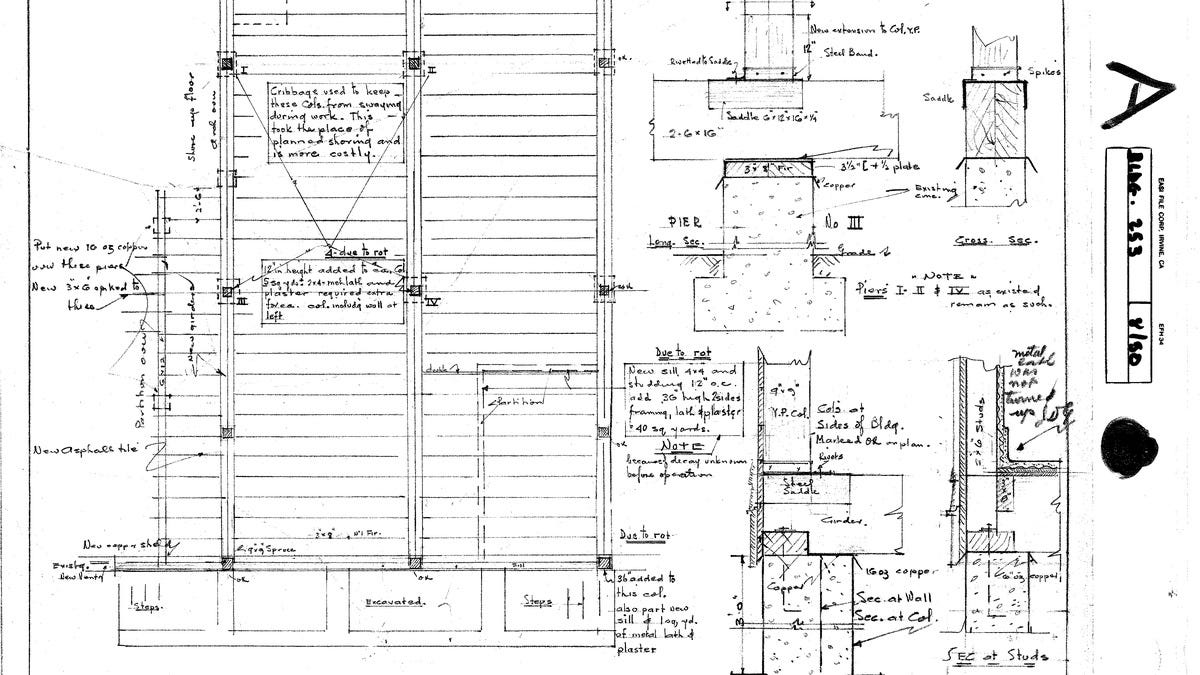
Builders solved this long ago. On a construction project there are design drawings, which describe the building someone intended, and as-built drawings, which describe the building that actually got built — where the pipe had to jog around a beam nobody drew, where a wall moved eight inches because of something discovered in week three. The as-built drawings are the only set worth trusting when you go back in to change something.
Almost nobody I’ve worked with has as-built drawings of their own company. They have the org chart, which is a design drawing. They have the process document somebody wrote for an audit, which is usually a design drawing too. And when they hand those to an AI and ask it to make things better, it does exactly what it was asked, with impressive fluency, against a building that is not there.
There was a good reason for that: an as-built drawing of a company was expensive. It meant weeks of interviews and sitting in on handoffs, with people describing the process they believe they follow, and the result went out of date the day it was printed. Plenty of companies sensibly did without.
That is what has changed. A lot of the evidence of how the work really happens already exists in writing — email threads, document versions, approval comments, tickets, meeting notes — and reading all of it patiently to reconstruct what actually happened is exactly the kind of unglamorous work LLM systems are now good at. What used to be cost prohibitive is becoming possible.
Here is how I would go about it. Pick one workflow — the one that hurts you and your customers the most today. Not the most interesting one, not the easiest to automate, and definitely not the one a vendor had a great demo for. The one that is visibly costing you opportunities, customers or revenue.
You no longer have to start by mapping a process by hand, with a stopwatch and a month of interviews. Most workflows leave a trail. Take responses to requests for proposal (RFPs): the emails, the document versions, the comments, the sign-offs. Turning that trail into a first map, and measuring the time between each step, is now easier than it has ever been — and checking it against a handful of real RFPs tells you whether it is true. That is where the longest delays show up, along with the places where quality quietly drifts, and you can start putting a number on what they are costing your operations.
From there, you define what good looks like, build the context around it and test it on real cases — and how to do that well is what I will get into in the next few pieces.
None of this transforms your company overnight. What the first real pass gets you is something I rarely see companies have: an honest picture of what actually happens, where it hurts, what it costs, and what a better result has to satisfy. Everything AI does for you afterwards gets measured against it.
So, where do you start? If you are reading a piece like this one, I suspect you started a while ago. You have the licenses, the chatbot that writes a perfectly decent email, a project or two set up in a burst of optimism, and at least one document lost somewhere between Claude and ChatGPT — which, as we have established, puts you in excellent company. Starting was never the hard part. Now figure out where your business gets stuck. The evidence has been sitting in your email threads and shared drives all along, and the tools you already pay for have read a good chunk of the internet. I am fairly confident they can handle your inbox.