


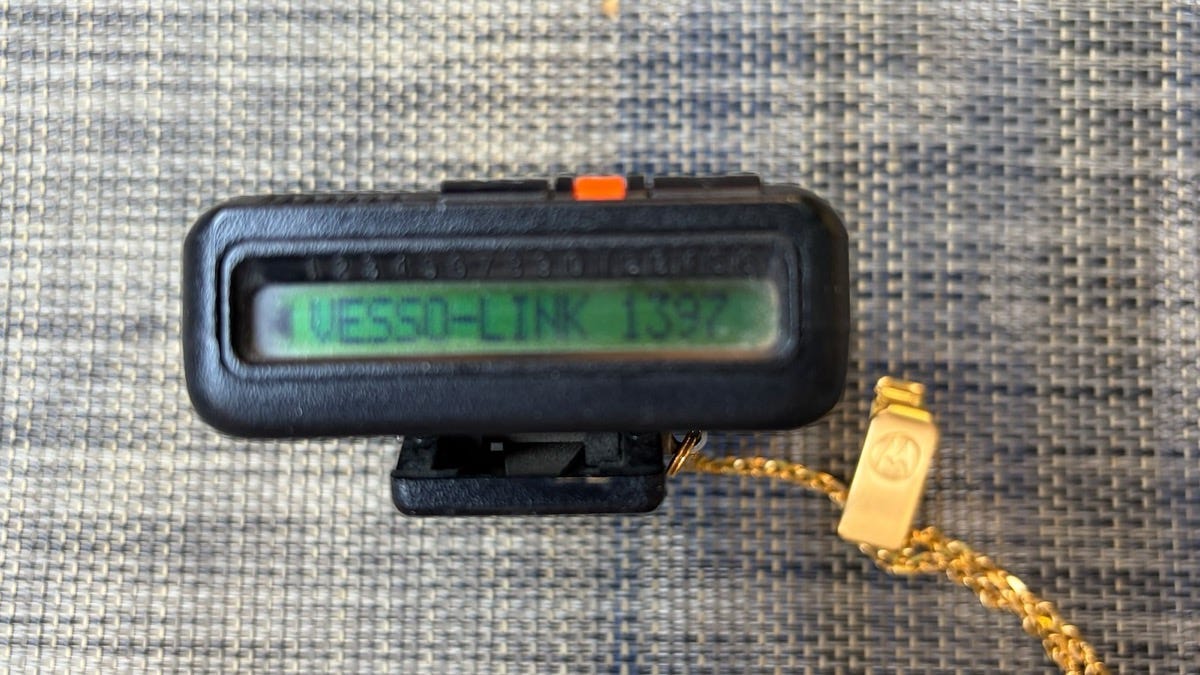
In the early 1990s, right out of college, I sold pagers in Moscow. (If you don’t know what a pager is: it was a small plastic box that received messages and could not send them. Someone called an operator, dictated a line, and it appeared on your screen a moment later — call your boss, urgent. Mine was subscriber 1397. The message found me instantly. Then I went looking for a payphone.) The Soviet Union had just come apart, the whole country was being rebuilt at once, and every company and government institution in the city was buying technology as fast as it could sign for it, trying to make up for decades of falling behind. My pitch was speed. Messages find you instantly. Decisions happen sooner. You run the business faster.
I gave that pitch to a government executive, and he heard me all the way out before answering with a question. “Do you know why humans and dolphins cannot communicate, even though dolphins apparently have a fairly sophisticated language?”
I did not.
“Because dolphins speak too fast,” he said. “Humans cannot process it quickly enough to hold a conversation. My organization is the same. What good is it to me if the messages arrive at the speed of light, when nobody here has the capacity to react to them?”
I was young and working on commission, so I am sure I said something upbeat and kept going. He bought the pagers in the end — the benefits were too obvious to refuse, and all of his peers were getting them — but he was the only person I pitched that year who understood what he was actually buying, which was more input, not more output.
I have thought about that man almost every week for the last several months.
Something shifted in my own work. I can produce documents at the speed of thought now; I think of a document and it exists. Meeting transcripts come back analyzed before I have finished walking to the car. I have finally become disciplined about capturing and distributing meeting notes, which I was never good at, because within minutes of a call ending the key points, the next steps, and a drafted follow-up email are sitting in my inbox waiting for me to glance over them and hit send. That used to take hours or days, or never.
So the input got dramatically faster, but my week did not get shorter. There is simply more of everything now — more emails and more reports and analyses that I have to actually read. Between five and twelve meetings in a week, nearly every one of them now producing a follow-up report and a list of action items.
Speeding up the input does not speed up the output. Humans have their own operating speed, and the response time of an organization is set by that speed, not by how quickly the document arrives. Ethan Mollick is making a similar point about AI adoption:

Let me make it concrete, because this is the part that shows up on no dashboard anywhere.
Not long ago I watched a team of five or six people build a final presentation for a large client. Every one of them used AI to draft their section. Every draft came back faster than it would have a year earlier. And then those drafts had to be read, corrected, reconciled against each other, and compiled into a single document, which took seven one-hour meetings with the whole project team. Call it thirty-five to forty-two team-hours of coordination, all of it after the writing was already done.
Now the honest part. Roughly the same coordination would have happened without AI. AI compressed the part of the work that each person did alone, and did not touch the part where the work has to come together. The drafting is the visible half. The integration is the half that eats the calendar.
That gap has a price, and I have started calling it the review-and-rework tax. It is the difference between a task getting faster and a workflow getting faster, and only one of those two things pays.
Most owners I talk to are already paying it without having named it. The first symptom is this: there are more documents and more emails hitting your inbox than there used to be, and you cannot get to all of them in time. That annoyance becomes a business cost: you stop following up while things are still hot. This can lead to losing opportunities and business.
But there is a different way to approach this problem. It happens when the tool stops being simply drafting help and the whole workflow gets rethought with an AI lens. We have been testing this with a smaller group, two or three people, on a real piece of work: market research pulled from multiple sources, turned into a go-to-market plan and a critical-path project. We defined precisely what the output had to be — the criteria, the length, the depth — then built a loop that coordinates the separate inputs, integrates them into one document, holds the format and the quality level steady, and checks its own work before any human sees it. The whole thing took a couple of days and one meeting.
Small sample. Both versions used the same tools, but the difference is that in the second one, somebody redesigned the workflow and handoffs.
Which brings up the question the redesign actually turns on: what has to be true for the review step to shrink without the quality dropping? For an owner or GM, the answer is trust, and trust is earned in a specific and unglamorous way. You have watched proposals get drafted for years and come back not quite to your standard — wrong formatting, wrong narrative, pieces that do not fit together. That standard is real, and it is made of things you have never written down — years of experience, a feel for the business, an understanding of particular customers, templates that only make sense to you. Capturing it is the critical step, and it is done the slow way, by asking a lot of questions, then a round of follow-up questions, then another, until it becomes clear. Then you can train the agent. Then the draft comes back seventy percent of the way there, and then eighty, and then ninety, and then ninety-five, until the point where you can give it a quick read and say it is good to go.
Until you do that work, every speed improvement upstream lands on the desk of the person who is already the constraint.
If you want to know whether you are paying this tax, you do not need a consultant and you do not need a quarter. Take one workflow that touches revenue — a proposal in response to a customer request is the best one to pick — and measure the clock, not the effort. From the moment the request arrives, how long before anyone starts on it? How long to a first draft? How long does that draft sit waiting for you or a senior manager to review it? How much back-and-forth follows? And when does it finally go out the door? Run that on your last five proposals from memory. The gaps between those timestamps are the workflow, and the drafting step is usually the smallest one on the list.
You can test that yourself, this week, on one workflow. I want to be clear about the limit, because the giveaway is worth nothing if I am vague about where it stops: measuring one workflow from memory is a first pass. Instrumenting an organization, redesigning the handoffs, and getting people to actually adopt the new version is a different job that takes dedicated capability. But nobody should be sold the second thing before they have done the first thing and seen the numbers for themselves.
My Moscow executive had the right analogy and the wrong conclusion. He was correct that speeding up one fraction of the system does very little when the rest of the organization cannot absorb it. He was too pessimistic about his organization’s ability to change, and I have watched that same pessimism be wrong over and over again since. The answer was never to slow the messages down. It was to think in terms of complete workflows instead of fractions of them.
He did buy the pagers. I would like to tell you I also sold him the redesigned organization, but I was twenty-something and I had no idea that was the actual product. The dolphins, as far as I know, are still waiting on us.