


Last January I walked the halls at CES with a sense that something significant was missing.
I spent a large part of my career building connected devices, bringing them to market, analyzing the industry, and eventually co-writing a book about it. For more than ten years, connected devices and solutions jumped at you from every corner of that show floor — the words “Internet of Things,” or sometimes “Internet of Everything,” printed across large sections of hundreds of booths. In 2025 they were still there, sometimes dressed up as AIoT. By 2026 the term had all but disappeared from the signage.
My first reaction was — did the Internet of Things become irrelevant to the tech world?
What had replaced it was a new vocabulary. Agentic AI was everywhere — the first time I remember hearing the phrase was Jensen Huang’s keynote the year before, where he also traced a line from perception AI through generative AI to physical AI. By 2026 both phrases were on sign after sign, along with edge AI, embodied intelligence, which mostly meant humanoid robots, and ambient automation. The last of those terms was interesting to me for a more personal reason: my co-author Daniel Kellmereit and I had argued for exactly that idea in The Silent Intelligence more than ten years before, when it did not have a name that fit on a banner.
So I did what you do at a trade show when the story stops making sense. I stopped walking and started looking at the products.
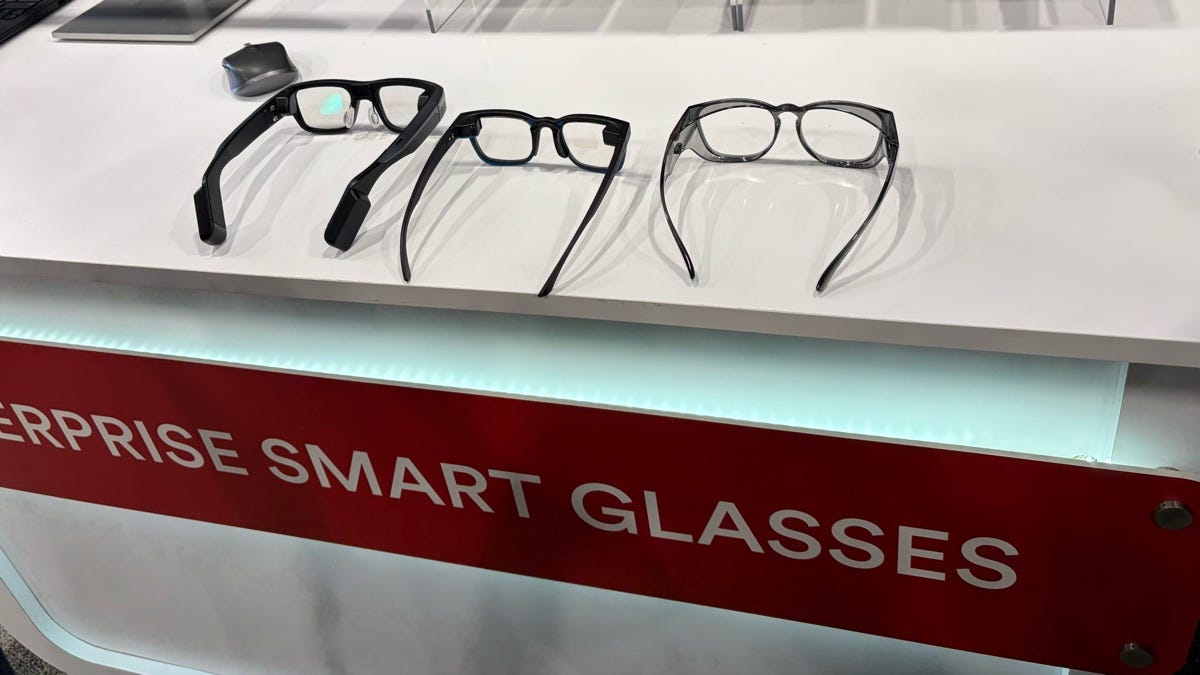
Vuzix was showing enterprise smart glasses — the Ultralite Pro and the LX1 — and pitching them as hands-free remote assistance and field service efficiency. A workflow pitch, not a technology pitch, which makes a lot more sense. But look at what these devices actually are underneath the marketing: head-worn computers with forward-facing cameras, streaming live video and a few sensors’ data to a cloud platform.
Vuzix was not selling the Internet of Things. Vuzix was shipping it.
That was the moment the trade show stopped reading as a defeat of IoT and started reading as something else. The label had not lost. The label had become unnecessary. Nobody prints “electricity” on a booth either.
Categories disappear for at least three reasons: the technology failed, the technology fragmented, or the technology got absorbed. The everything-on-a-blockchain wave largely failed; what survived was a narrow financial use case wearing the same word. 3D printing fragmented into a dozen industrial niches with nothing binding them. The test that separates absorption from the other two is not whether people still say the word. It is whether the capability is still doing essential work inside something people now buy for a different reason. On that test, connectivity did not retreat from CES. It moved into the walls.
The clearest version of this I have seen is not at a trade show at all. It is on my mother-in-law’s arm.
She has a continuous glucose monitor, or CGM. It is roughly the size of a bottle cap, she wears it on her upper arm under her sleeve, and the readings appear on her phone. When she first got it she showed it to us, and what struck me was not the technology but her relationship to it: she was showing us a thing that helps her, the way you would show someone a new pair of glasses. Not a device. Not a platform. A thing that helps.
I know what that product looked like in 2013, because in 2013 I was writing about it. It was bulky. It needed a separate receiver roughly the size of a pager to talk to the network — a second object to carry, charge and lose. And getting it to talk to anything else was a genuine undertaking; plenty of people never got it working at all. Every part of that experience announced itself as technology targeted to consumers who had no inclination to become system integrators.
Today none of it announces anything. It sits under a sleeve and it works. My mother-in-law could not tell you what protocol it uses and has no reason to care. That is not the technology failing to impress her. That is the technology finishing its job.
This is where I would like to recall what we were predicting when we wrote our book over ten years ago, and I am going to include a couple that are off, because a piece like this is worthless without those.
In 2013 The Silent Intelligence documented a set of ideas that sounded like science fiction to some readers. Dr. Sanjay Sarma of MIT described, among other things, a car with an exact avatar in the cloud — a physical vehicle with a software twin that he could lock, unlock and start from his phone. In 2013 that was a research position. Today remote locking and unlocking, remote tracking of your car, and remote diagnostics are line items on a spec sheet, and nobody buying a car calls it IoT; they call it convenience.
What we probably missed was the number itself. We repeated Ericsson’s fifty-billion-by-2020 forecast, and by any way of counting the real figure came in well short of it — though how short depends entirely on what you agree to count. In my own household I can find something like twenty-five connected things, cars and phones included, though not all of them are talking over a cellular network. That was never really the point of Ericsson’s report. The point was to draw everybody’s attention to what the technology could do, and at that it succeeded completely.
Another prediction that was a little too optimistic came from Astro Teller of Google X. He told us that self-driving cars would soon be meaningfully better than people, and that it would become irresponsible and antiquated for a person to drive a car — absolutely going to happen, he said, in the next decade. It has been more than a decade. We are not quite there. But we can now see a future in which that is no longer science fiction.
There is a reason the book was called The Silent Intelligence. We chose the name because most of the activity and growth in the space was happening outside of mainstream visibility — who cares that their electric meter just became smart and connected, and yet the implications were enormous. Assaf Biderman of MIT’s SENSEable City Lab put it more sharply: computers are becoming so small that they are vanishing into things. That was the whole thesis. Thirteen years later, that walk through CES was the thesis proving itself.
Which brings me to the question I actually care about a lot more these days.
If IoT won by disappearing, what does that imply about AI?
I think we will know AI has won when a keynote stops advertising it. Walk into CES 2036 and be surprised by how little anyone says the word. In the meantime, the work itself will have changed shape. I do not think the future is about people opening more chatbots and choosing between models. I think the destination is closer to this: you set intent and constraints, and the operating layer of your business handles the execution underneath — reconciling schedules, catching the clash between your plan and a client’s system, and surfacing the three things that genuinely need a human decision. What stays with people is what should have stayed with people all along. Deciding what the business is for. Setting the goals. Sitting across from another human being and agreeing on a plan.
There is a way to tell where you actually are, and it costs nothing.
Take one process that matters and separate it into two lists: the parts that genuinely require you — the decisions, the judgment calls, the gates where someone has to be accountable — and the parts that only require someone. Then watch what happens to the second list over the next quarter. If handing off a piece of it is still a project every time, with a kickoff and a champion and a slide, the technology has not arrived yet; it is being installed. When it stops being an undertaking and becomes the ordinary way that work goes out the door, you are there. And nobody will announce it.
You will notice this test is really about workflows rather than roles or departments, and that turns out to be a much bigger argument than it looks — big enough that it deserves its own week. I will talk about it in a lot more detail next time.
Until then, I would gently suggest that the highest compliment your customers can pay your shiny new capability is to stop mentioning it entirely. It means they have started depending on it instead. My mother-in-law has never mentioned the word “sensor” to me, and her CGM is the most successful piece of technology I saw all year.