


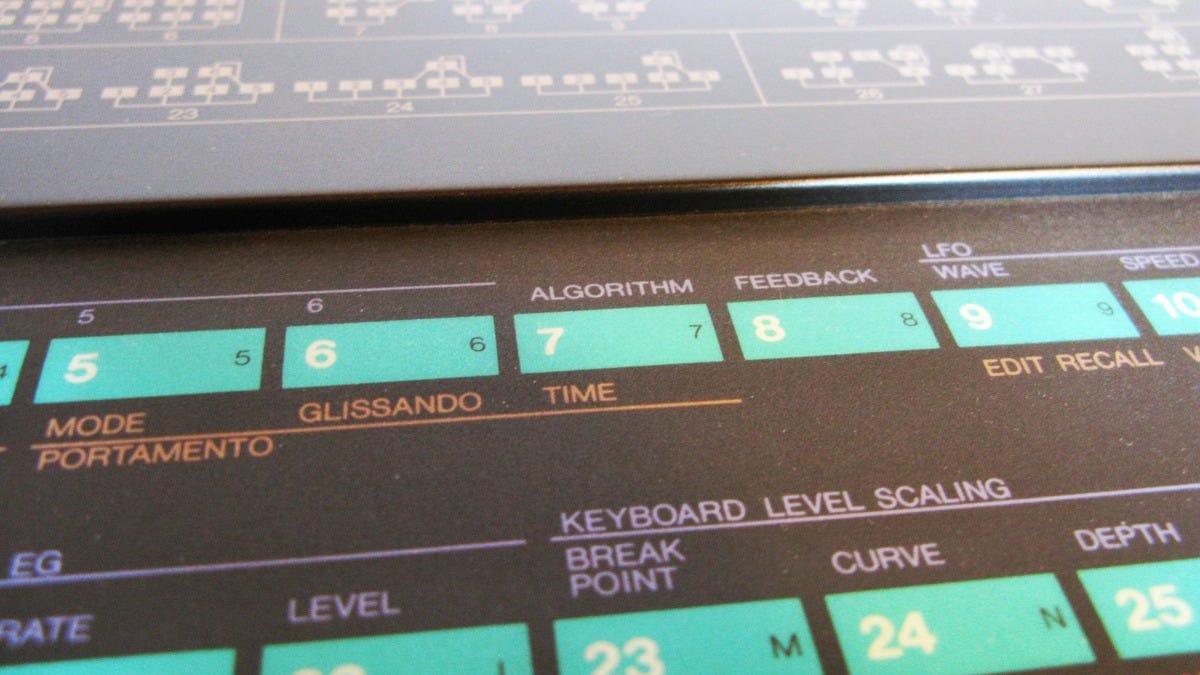
The Yamaha DX7, launched in 1983. Keys 7 and 8: Algorithm, Feedback. Photo: Leo-setä, CC BY 2.0, via Wikimedia Commons.I was a teenager in Moscow in the late 1980s when a distant relative who played in a popular band invited me to hang out at their studio, on the understanding that I would not draw too much attention to myself.
It was a proper studio, with separate rooms for vocals and for guitars, and a room of its own full of keyboards — a Yamaha DX7, a Roland, a Korg — all of them left switched on. At some point the band went out for a smoke. I went straight to the keyboards and started playing, and I was blown away by all the sounds that came out. I felt like I had gone into space and the only limit was my imagination.
You have to understand what a school band looked like where I grew up. Drums, bass, one or two guitars and a vocalist, and sometimes a keyboard player on horrible-sounding electric keys from East Germany. None of us had ever heard anything like what was in that room. Who needed a drummer or a guitar player if one or two boxes could produce all that?
And then, just as quickly, I was overwhelmed. I had no idea about sequencing, programming a drum machine or layering. More or less the whole band was in the room with me, and I had no way of getting it to play a song. I did not have the words for it then, but I had just met the first half of an idea that has stayed with me ever since: capability arrives before craft.
It only became obvious to me much later what a revolution synthesizers made in music, and how much they democratized making it. Yamaha launched the DX7 in 1983, and it became one of the best-selling synthesizers in history. Through the decade, a particular shape of act kept turning up in the charts: a singer out front, and one person in the background doing much of the rest. Soft Cell, Yazoo, Eurythmics, Pet Shop Boys and Erasure, to name a few. It was the moment when a person with talent could write the music and build much of the sound, needing a good singer rather than a whole band.
So synthesizers handed superpowers to individual performers and small bands. The boxes could make almost any sound you asked for; they could not tell you which ones were worth keeping, and writing something people would still want to hear decades later was as hard as it had ever been. By themselves, they could not produce a masterpiece, and they could not produce a single listener.
I have been thinking about that studio a lot lately, and not because of music. Every so often we get superpowers delivered to us. In the 1980s it was synthesizers, and they went to musicians and bands. Now it is AI agents, and they are going to pretty much everyone, for pretty much everything. I am back in that studio, and so, I suspect, are you.
In January, Marc Andreessen described what AI is doing to the people who build software as a Mexican standoff. “Every coder now believes they can also be a product manager and a designer, because they have AI,” he said on Lenny’s Podcast. “Every product manager thinks they can be a coder and a designer. And every designer knows they can be a product manager and a coder.” That is the synthesizer moment again — one or two boxes that seem to contain the whole band.
He has a point — AI has just delivered superpowers to product managers, designers and developers alike. For simple products it is already possible to move forward without a developer; for anything complex the craft still matters, but the gap between producing sounds on the instruments and creating a masterpiece is exactly where I found myself as a teenager. And I’m not a neutral observer. With AI agents, I have been building software I never thought I would be able to build without a team of developers.
The one I use every day is a knowledge engine for my own business. It captures evidence, claims, facts and assumptions, synthesizes knowledge files from them and — this is the important part — keeps the knowledge separate from the output. Anyone who does knowledge work knows the problem this solves: you remember a good slide, or a graph, or a paragraph with exactly the right story in it, and you cannot find it to reuse it. My firm’s knowledge no longer lives inside the deck or the document; I can go back to it and build whatever the output needs to be — a presentation, a white paper, a web page, or the piece you are reading now.
There is a synthesizer parallel here, too. Those machines could store a sound, or a bass line, and bring it back for the next song on the same album. Being a Depeche Mode fan, I can still tell which of their 80s albums a song belongs to just by the way it sounds. A knowledge engine does something similar for a business: whatever the output, it draws on the same stored material, and it sounds like you.
Which does not mean the boxes guarantee quality and secure distribution by themselves.
I am still defining the direction, which means I have to be clear about what I want from the system and why. Fortunately I don’t deal with frustrated developers; I deal with a friendly agent that doesn’t always do what I ask, is endlessly eager, and sometimes has brilliant ideas about how to execute that I would never have arrived at myself. But for all that help, it cannot, on its own, produce something other people would actually want to read, and it cannot find my audience or my clients for me. Deciding what good looks like, and finding the people who need it, is still up to me — and distribution, now as in the 1980s, is still the bottleneck.
It is easier than ever to build an AI gizmo, or a whole platform, and for exactly the same reason it is easier than ever to drown in the ocean of new AI gizmos and platforms. Standing out and persevering is as hard as it was before; that part is not getting easier. Look again at Andreessen’s standoff — the coder, the product manager and the designer, each convinced they can now do the other two jobs. There are three people in that standoff, and not one of them is the customer. Somebody still has to find out what customers actually want, test it with them, and work out how to get it to them — and no amount of AI in that standoff does that job for you, although it helps a lot.
So what should an owner take from this? Building a gizmo usually assumes you already know which features the customer wants, and in a world where building and iterating just became very cheap, that assumption is the most expensive thing. The flip side is genuinely good news. A custom solution — built around one customer’s actual workflow rather than a feature list somebody imagined — is becoming both less costly to make and, I think, more valuable to own. Listening to customers, and understanding their workflows and their problems, matters exactly as much now as understanding their fans did for a band in the 80s.
If someone in your company is excited about building an AI tool — and that someone may well be you — ask yourself: can you name the customer, describe the workflow it fits into, and point to the problem in that workflow it removes, in their words rather than yours? If you can, the cheap boxes are a gift. If you can’t, you are the kid in the studio: blown away by the sounds, with no idea yet what song you are playing, or who is going to listen.
I had that room to myself for roughly as long as it took a Moscow rock band to finish a cigarette, and I spent every minute of it making sounds — none of which, I am fairly confident, anybody has wanted to hear since. The boxes have improved beyond recognition in the nearly forty years since. The audience, as far as I can tell, is exactly as hard to come by.
Nice analogy! Thanks for posting.
Lowering the barriers to entry increases supply, but not demand. Craft is a great term for what differentiates the supply, and remains human-led.
Which reminds me of one more name for the synthesizer-enabled set: Kraftwerk.
Quick etymology rabbit hole. German Kraft retains the older meaning of power, while in English it shifted to mean skill or art. Another way of distinguishing ability from value.