


A friend of mine built a compliance software company out of nothing, and for a long time the fact that he touched everything was the reason it worked.
Every decision in that company was his, and that was not a flaw — it was the engine. He chose which customers to chase and which to walk away from. He set the prices. He decided who got hired, and what the product would refuse to do no matter who asked. In a company that small the founder is the strategy, the quality department and the culture all at once, and he was good at all three. It worked. Years later the company is still here, still selling, still steady, with fewer than fifty people, mostly developers and a handful in sales and support.
And he still runs it exactly the way he ran it then. Every hiring offer crosses his desk before it goes out — every one, regardless of the role. So does every customer renewal. Which would be fine, except that his desk is also where everything else in the company is queued. An offer can sit for two weeks. Sometimes three.
Picture that from the other side of the building. Someone has spent weeks finding a developer to replace one who is retiring. Interviews, debriefs, a reference call taken on a Saturday. The candidate is excellent and everyone agrees. The offer goes into the founder’s inbox on a Tuesday and then simply stops existing. Week one, you tell the candidate it is moving. Week two, you say these things take a little time. Week three, you stop calling, because there is nothing to say and you can hear what they are thinking, which is that this is what the company will be like to work for. Then they take the other offer…
The easy version of this story is unfair to the founder. He is doing precisely the thing that built the company, at a size where it no longer fits. The care is real, and it is the same care it always was — it has simply outlived the conditions that made it efficient.
I have watched some version of this in almost every founder-led company I have been inside. And I have been thinking really hard about how you would actually fix it — not by lecturing an owner about delegation, which never works and is usually wrong anyway.
Then I remembered something written more than eighty years ago.
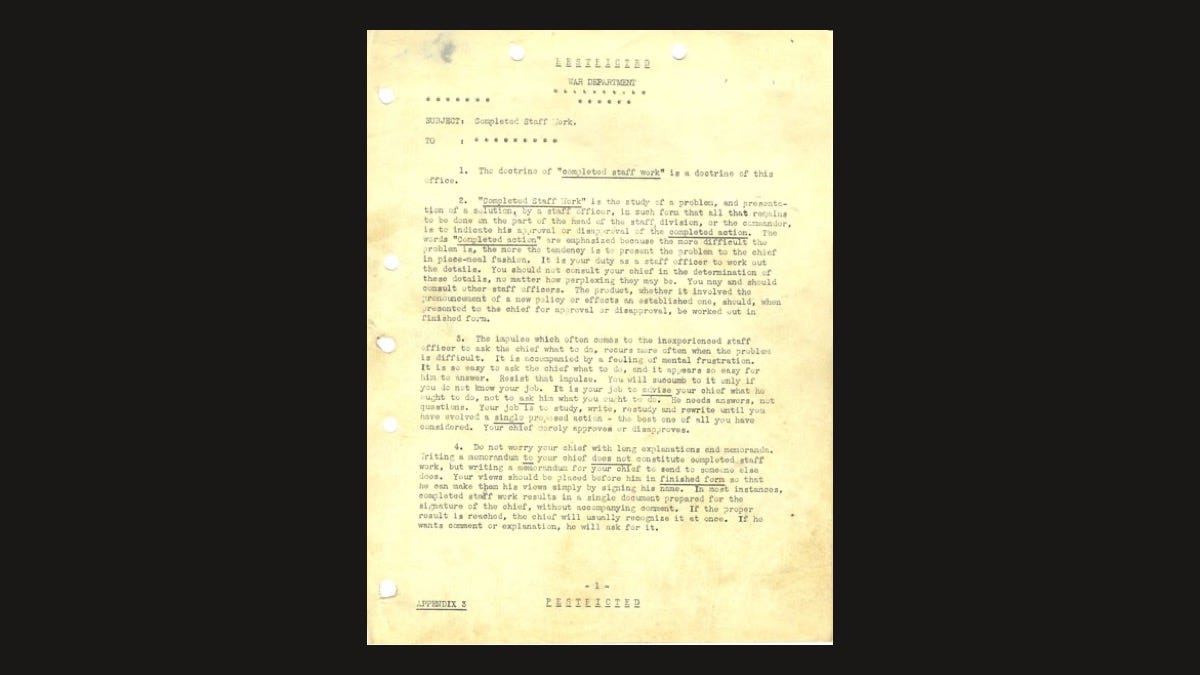
The Doctrine of Completed Staff Work is usually traced to a one-page War Department memo from January 1942. Its rule was almost brutally simple: a staff officer’s job is not to bring the commander a problem, it is to bring him a finished decision the general can dispose of with a signature. If the commander has to open a filing cabinet to check a fact or call a meeting to fill a gap, the staff officer has failed.
Take the uniforms off and the principle holds: the burden of preparation belongs to the person asking for the decision, never to the person making it.
So why doesn’t every company on earth run this way? Because until now it was getting too expensive. Collecting all the necessary data and documents for a single decision was becoming more work than anyone wanted to do. So instead we forward the thread, attach the spreadsheet, add “thoughts?” and let the boss figure it out. The economics killed it.
But that expensive part just got potentially very affordable.
Not only because the document search, analysis and drafting now takes minutes, but primarily because it is now possible to capture and store what good looks like. Not as a philosophy. As a list. What are the three, or five, or seven things you look at before you approve a job offer?
Which of those things are you deciding, and which are you only checking? Setting the pricing policy is a decision. Confirming that an offer sits inside a band he set himself is a check. The same inbox, the same subject line — but they should not be getting the same afternoon.
Write those checks down and they stop being a feeling. They become something a machine can prepare against — and this is the fork where AI either helps or makes everything worse. Ask a chatbot about the problem and all you have done is produce more plausible material for the same tired person to inspect. The version that works is narrower and much duller. Give an agent the written criteria, the policy it has to satisfy, the data it may look at, and the exact shape of the page it must hand back. Include the pay history for the role, the offer tested against his own policy, the last few exceptions and why they were granted, and the one item that falls outside the lines. Same page, same format, every time.
He does not have to be removed from anything. He is getting a decision instead of an assignment, and the whole goal is to make saying yes take ten seconds.
This will not work for everyone. Some owners will never write the list down, because the list is the thing they are least sure of. Some will write it and go on opening every email anyway.
But for the ones who will, this is the most leverage I have seen available to a small company in a long time. A company of a handful of people can now afford the kind of preparation that used to require an actual staff. That is what punching above your weight looks like — not more hours, but arriving super prepared at every decision.
You can test the whole idea this week, for nothing. Pick the approval that stalls most often in your business. Ask whoever prepares it what you always send it back for. They will answer faster than you can, because they have been reverse-engineering your standard for years. Write down what they say, in their words. That list is the thing.
I expect two objections to this, and I want both. The first is that the list cannot be written — that what you are doing is judgment, not criteria, and the moment you write it down you lose the thing that made it work. The second is that the gate was never really about preparation, so making the preparation free changes nothing. I think the first one is usually wrong and the second one is sometimes right, and I would rather argue about it than be agreed with politely.
As for my friend, I have not offered to fix any of this, because a friend who diagnoses your company over dinner does not stay a friend for very long. He can keep the final word. But if answering an approval request takes a fresh cup of coffee, two spreadsheets and an empty afternoon, it is not an email — it is a surprise meeting wearing a PDF attachment.
Whoever wrote that memo in 1942 managed to say all of this on a single page, in the middle of a war, without so much as a photocopier. This version took me eight drafts, a research detour, and a small committee of AI agents arguing with one another about the ending. I suspect they would find that hilarious — and they would probably be right.